This is part of The Contract Manufacturing Playbook, a series sharing strategy and execution insights from 45+ years of building supplements for leading brands.
Executive Summary
The dietary supplement industry is experiencing a shift in consumer attention from active ingredients to the full label, and excipients and emulsifiers are now under scrutiny that brands must actively manage. These functional ingredients ensure dose uniformity, shelf stability, and consistent product performance, making them essential to formulation rather than optional additions. For brands working with a supplement contract manufacturer, treating excipients with intentionality has become a meaningful brand differentiator that directly supports consumer trust. How a product is formulated is now as commercially significant as what it contains.
Key Takeaways
- Excipients are formulation tools, not liabilities, and brands that treat each inactive ingredient as a functional necessity with a clear, documented purpose are better positioned to meet clean label expectations without sacrificing product performance.
- Consumer scrutiny of full ingredient panels has created a perception gap that brand strategy must now close, because today’s buyers evaluate inactive ingredients with the same skepticism they apply to active ones, making transparent and explainable formulations a competitive differentiator.
- Excipient strategy starts with manufacturing partner selection, and brands that prioritize partners with strong R&D capabilities, GMP-certified processes, and transparent documentation build formulations that perform consistently and support a cleaner brand story.
- What Are Excipients and Emulsifiers?
- Why Excipients Are Under Scrutiny
- Common Myths About Excipients and Emulsifiers
- The Real Opportunity: Smarter, More Intentional Formulation
- How Formulation Impacts Commercial Success
- What to Look for in a Supplement Contract Manufacturer
- What Sets Reliance Apart?
- Final Thoughts
- Frequently Asked Questions About Excipients in Dietary Supplements
- Looking for a Supplement Contract Manufacturer That Balances Performance and Clean Label Expectations?
In today’s dietary supplement market, the conversation is changing.
For years, innovation centered on active ingredients such as vitamins, minerals, adaptogens, and botanicals. Now, brand managers and product developers are facing a new layer of scrutiny from consumers:
What else is in the product?
Excipients, emulsifiers, and other inactive ingredients are no longer invisible. They are being questioned, analyzed, and often misunderstood.
For brands working with a dietary supplement contract manufacturer, this shift presents both a challenge and an opportunity. How you formulate is now just as important as what you formulate.
What Are Excipients and Emulsifiers?
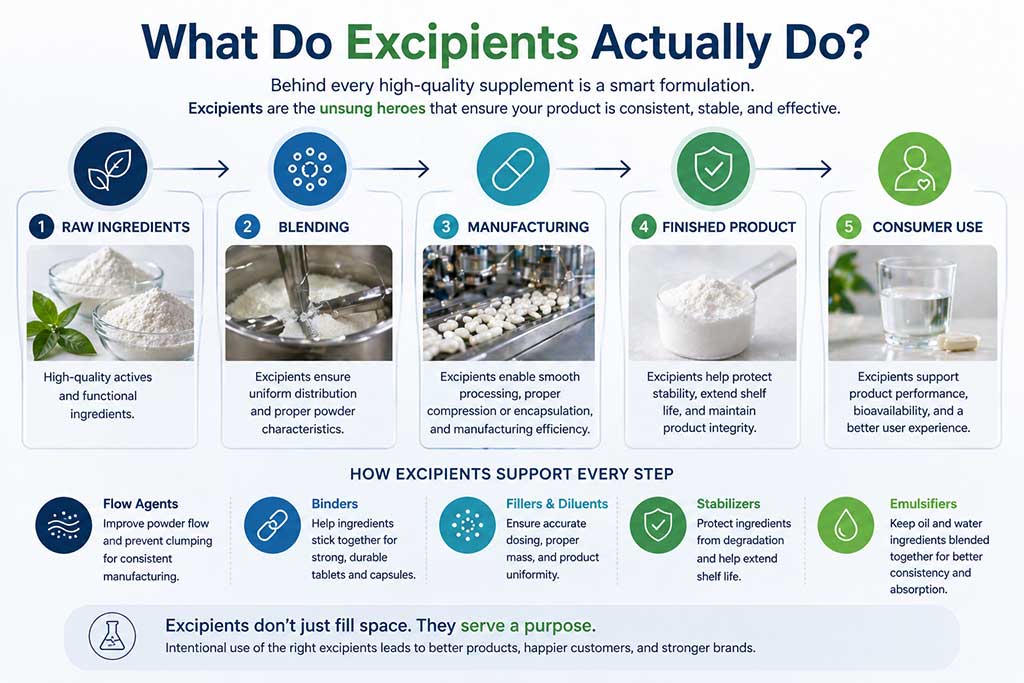
Excipients are functional, inactive ingredients that support the manufacturing process, stability, and delivery of dietary supplements. While they do not deliver the primary benefit, they are essential to ensuring the product performs as intended.
They help ensure consistent dosage, enable efficient large-scale manufacturing, maintain shelf stability, and improve usability across supplement delivery formats such as tablets, capsules, and powders. Choosing the right format strategy to minimize excipient complexity is a key lever for brands seeking cleaner labels.
Emulsifiers are a specialized type of excipient used to stabilize mixtures that would otherwise separate, such as oil and water. They are particularly important in softgels, liquid supplements, and functional powder formats where consistency and bioavailability are critical.
From a formulation standpoint, these ingredients are not optional. They are functional tools required to deliver a reliable product.
Why Excipients Are Under Scrutiny
The rise of the clean label movement and increased consumer awareness has shifted attention toward full ingredient transparency.
Today’s consumers are:
- Reading full labels, not just front-of-pack claims
- Researching unfamiliar ingredients online
- Questioning complexity and perceived “additives”
- Expecting simpler, more explainable formulations
Industry data reinforces this shift. According to the Council for Responsible Nutrition (CRN), consumers are increasingly evaluating entire ingredient panels, not just active ingredients, when making purchasing decisions.
This creates a growing gap between formulation science and consumer perception. Brands must now manage both.
Common Myths About Excipients and Emulsifiers
Myth 1: Excipients Are Just “Fillers”
This is one of the most persistent misconceptions. In reality, excipients are essential to ensuring dose uniformity and manufacturing consistency.
For example, flow agents such as magnesium stearate prevent ingredients from sticking to equipment, allowing for consistent capsule fill weights and efficient production. Without them, both product quality and manufacturing reliability can suffer.
Myth 2: Synthetic Ingredients Are Unsafe
The assumption that synthetic equals harmful continues to influence consumer perception. In practice, safety is determined by dosage, exposure, and scientific validation.
Many commonly used excipients fall under the FDA’s Generally Recognized as Safe (GRAS) designation, meaning they are considered safe under their intended conditions of use based on scientific review.
Myth 3: Clean Label Means No Excipients
An excipient-free supplement is rarely viable at scale.
Even the most streamlined formulations require functional ingredients to maintain stability, ensure manufacturability, and deliver a consistent user experience. The real objective is not elimination, but intentional and minimal use.
Myth 4: Emulsifiers Are Universally Harmful
Concerns around emulsifiers have gained traction, often based on studies using high doses or non-human models.
In real-world supplement applications, dose, formulation context, and intended use matter. Approved emulsifiers are used at controlled levels and often play an important role in improving consistency and absorption. According to the FDA, GRAS-designated ingredients are considered safe under intended conditions of use.
Broad generalizations do not reflect how these ingredients are actually used in supplement contract manufacturing.
The Real Opportunity: Smarter, More Intentional Formulation
For brands working with a contract supplement manufacturer, this shift creates a clear opportunity to differentiate.
The most successful formulations today are not defined by what they exclude, but by how thoughtfully they are built.
A useful guiding principle is simple: every ingredient should have a clear purpose. The same logic applies to the active side of the label, where branded ingredient strategy is equally reshaping how brands think about differentiation and consumer trust.
This approach leads to:
- More transparent, easier-to-understand labels
- Stronger alignment with clean-label expectations
- Greater consumer confidence at the point of purchase
At Reliance, this philosophy is captured in a simple idea: that which does the least, does best.
How Formulation Impacts Commercial Success
Excipients now sit at the intersection of cost, performance, and perception.
Formulation decisions directly influence how a product is received in the market. Overly complex formulations can introduce unintended challenges, including longer ingredient lists, difficulty in communicating value, and a perception of lower quality.
CRN data shows that trust is one of the primary drivers of supplement purchase and repeat usage, reinforcing the importance of clear, intentional formulation strategies.
In contrast, well-designed formulations create measurable advantages:
- Clearer labels that support brand storytelling
- Stronger positioning in premium categories
- Increased likelihood of repeat purchase
This is where formulation becomes a strategic business lever, not just a technical requirement.
What to Look for in a Supplement Contract Manufacturer
Not all manufacturers approach excipients with the same level of rigor. The right dietary supplement manufacturer will treat them as a critical part of overall product design.
Look for partners that offer:
- Strong in-house R&D capabilities to optimize formulations
- GMP-certified manufacturing processes for consistency and compliance
- Transparent documentation, including Certificates of Analysis (CoAs)
- Experience across formats such as capsules, powders, and stick packs
These capabilities ensure that excipients are selected not just for function, but for alignment with your brand strategy and market expectations. For a comprehensive evaluation framework, the supplement contract manufacturing guide and 10 Key Factors for Picking the Ideal Supplement Contract Manufacturing Partner cover the full scope of capabilities and qualities to evaluate.
What Sets Reliance Apart?
At Reliance, excipients are approached with the same level of scrutiny as active ingredients.
Our formulation philosophy is grounded in purpose. Every ingredient must justify its inclusion based on performance, manufacturability, and overall product integrity.
With in-house R&D, rigorous testing, and fully integrated turnkey supplement contract manufacturing capabilities, we help brands balance scientific precision with evolving consumer expectations.
With over 45 years of experience, we partner with brands to create supplements that perform consistently, meet regulatory standards, and build lasting consumer trust.
Final Thoughts
Excipients and emulsifiers are not the problem.
But they are no longer invisible.
Consumers are reading full labels, asking harder questions, and rewarding brands that provide clear answers. The goal is not to remove everything extra, but to ensure that every ingredient serves a clear and necessary purpose.
Because in today’s supplement market, success is not about having less.
It is about proving that everything included belongs there.