

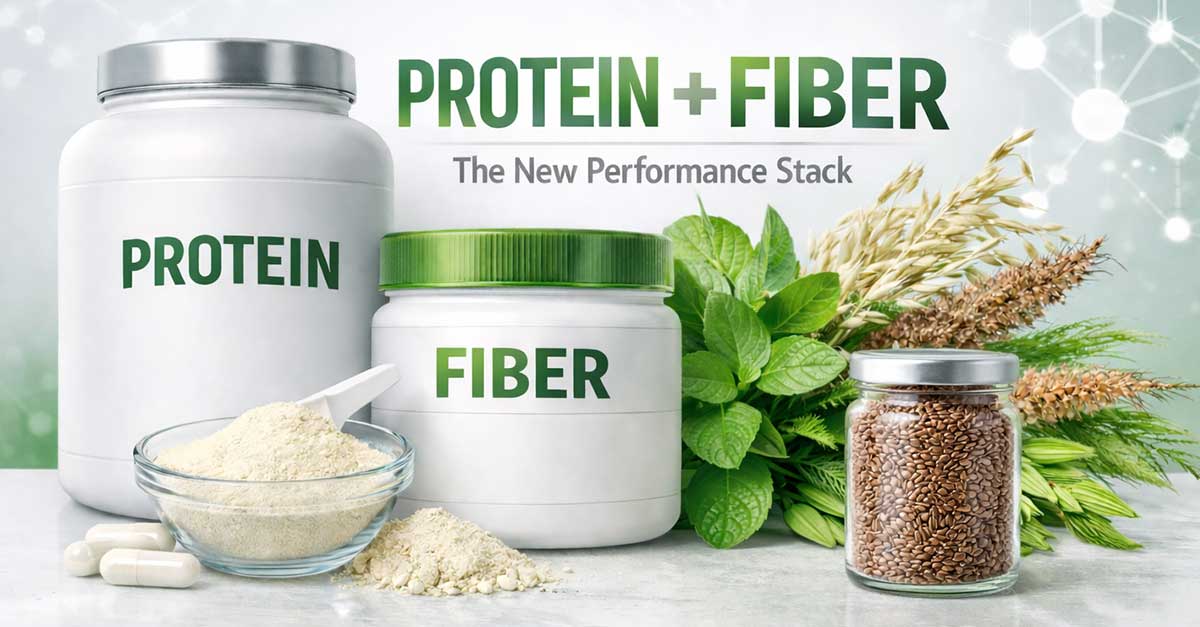
Fiber is transitioning from a secondary nutrient to a core growth driver in the dietary supplements and functional nutrition market. SPINS data shows accelerating omni-channel sales, expanding format adoption, and increasing private label penetration, signaling that fiber is becoming a foundational macro rather than a niche claim. For supplement brands, this shift creates strategic opportunities in product reformulation, paired nutrient systems such as protein plus fiber, and format innovation aligned with GLP-1-driven portion behavior. Companies that treat fiber as a formulation strategy, not an add-on, will be better positioned for sustainable portfolio growth and competitive differentiation.
Key Takeaways
- Fiber is moving into the mainstream across supplements, beverages, and everyday nutrition formats, making it a portfolio-level decision rather than a single-SKU opportunity.
- The most defensible growth strategy is integrating fiber into existing products through intelligent reformulation and nutrient pairing, especially alongside protein and probiotics.
- As private label expands in fiber, branded companies must compete on formulation sophistication, quality assurance, and manufacturing execution to protect margin and differentiation.
- Fiber Is No Longer the Quiet Nutrient: What Supplement Brands Need to Know
- What Is Driving Fiber’s Acceleration?
- Protein Plus Fiber: The New Performance Stack
- Private Label Is Reshaping the Fiber Conversation
- What This Means for Supplement Innovation
- What Sets the Right Manufacturing Partner Apart?
- Fiber Is Becoming a Design Principle
- 3 Questions Consumers Ask About Fiber
- What This Means for Brands Working with Reliance
- Ready to Build the Next Generation of Fiber-Forward Supplements?
Fiber Is No Longer the Quiet Nutrient: What Supplement Brands Need to Know
Protein still grabs headlines.
Fiber is moving from secondary to essential.
According to SPINS 2026 Trend Predictions, fiber represents the largest nutritional gap in the American diet, and brands are finally responding at scale.
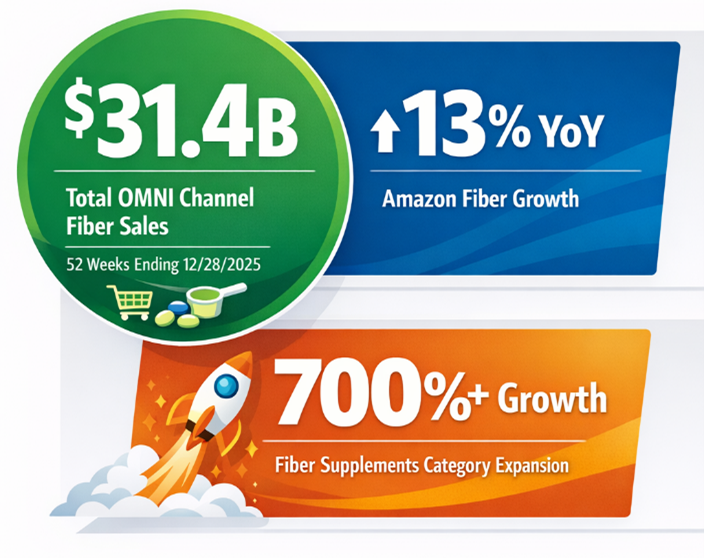
Across omni-channel, fiber reached $31.4B in sales for the 52 weeks ending 12/28/2025, with Amazon up 13% year over year.1 That level of growth marks a structural shift. Fiber is no longer a niche functional claim buried on the back panel. It is becoming a core macro with mass-market relevance.
For brand managers, R&D leads, and procurement teams, the question is no longer if fiber belongs in your portfolio. The question is how strategically you integrate it.
What Is Driving Fiber’s Acceleration?
Fiber’s growth is not just about volume. It is about where it is showing up.
SPINS data shows FDA-designated high-fiber products expanding well beyond traditional supplements into breakfast foods, RTD tea and coffee, and even soda. While supplements remain the fastest growth engine, up over 700%, diversification across everyday formats is the real signal.1
This mirrors protein’s trajectory over the past decade. Protein first gained momentum in traditional supplement formats such as powders and capsules. From there, it expanded into performance-oriented bars and ready-to-drink shakes, becoming a staple in fitness and active nutrition. Eventually, protein moved beyond the gym and into mainstream food and beverage. It began appearing in everyday snacks, cereals, yogurts, coffees, and even indulgent products positioned as better-for-you options.
Fiber’s expansion is shifting from niche to mainstream products.
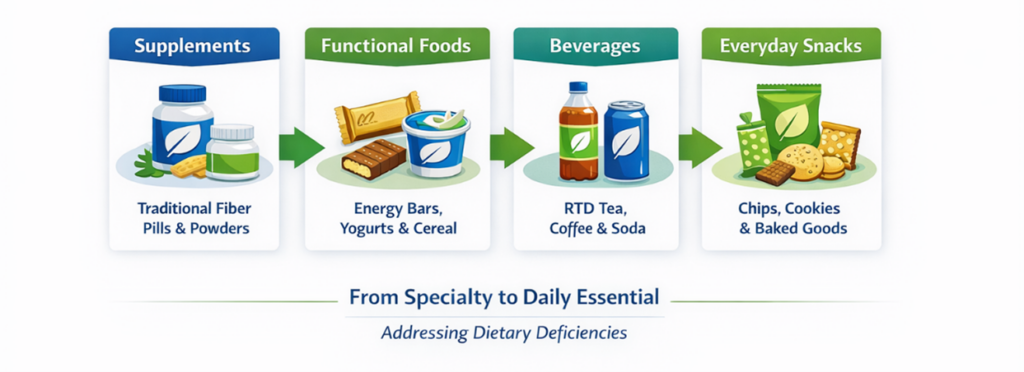
Fiber is now following that same evolution. What began as a supplement category is steadily embedding itself into daily routines across multiple food and beverage occasions. It is transitioning from a specialty attribute to an everyday expectation.
SPINS frames this shift as a pivot away from protein excess toward correcting real dietary deficiencies, with fiber now fully appreciated as a macro rather than an add-on.1
Protein Plus Fiber: The New Performance Stack
The story is no longer protein versus fiber.
It is protein plus fiber.
Smaller portion sizes, driven by GLP-1 usage and broader lifestyle shifts, are forcing nutrition to work harder per bite or sip. Nutrient density now matters more than sheer volume.
Protein
- Supports satiety
- Contributes to muscle maintenance
- Drives performance positioning
- Associated with active nutrition
Fiber
- Supports digestive health
- Helps maintain metabolic balance
- Extends fullness and satisfaction
- Addresses the largest dietary gap
Protein supports satiety and muscle health.
Fiber supports digestive health, metabolic balance, and longer-lasting fullness.
Together, they solve the same modern problem from two sides.
That is why fiber-forward ingredients such as FOS (Fructooligosaccharides), which is up over 170% in unit growth, along with tapioca soluble fiber, acacia fiber, and inulin, are accelerating.1
For product development teams, this means reformulating existing SKUs rather than simply launching new ones. For brand managers, it means repositioning around balanced performance rather than extreme dieting.
Private Label Is Reshaping the Fiber Conversation
One of the most notable developments in fiber is the performance of private label.
SPINS reports that private label now represents the largest share within fiber, nearing $4B in sales and delivering significant incremental growth over the past year.1
This signals that fiber is firmly entrenched in mass-market nutrition.
When private label invests heavily in a nutrient, it typically means consumer demand has reached critical mass. Fiber is no longer experimental or trend-driven. It is becoming a foundational expectation.
For branded supplement companies, this shift raises the bar:
- Consumers now expect fiber to be accessible and affordable
- Functional benefits must be clearly communicated and differentiated
- Quality, sourcing transparency, and formulation sophistication become key advantages
Unlike commodities, fiber-forward supplements still offer significant room for innovation. Branded products can differentiate through:
- Advanced fiber systems that combine soluble fibers, prebiotics, and probiotics
- Clinically supported ingredient choices
- Superior taste and mixability in powders and stick packs
- Targeted positioning for digestive health, metabolic support, or GLP-1 complementary routines
For procurement and supply chain teams, the takeaway is clear. As fiber becomes more mainstream, execution matters more than ever. Partnering with a GMP-compliant contract manufacturer that can ensure batch consistency, proper documentation, and scalable production is what protects brand equity in an increasingly competitive space.
Fiber is expanding. The brands that approach it strategically, not generically, will capture the most long-term value.
What This Means for Supplement Innovation
Fiber’s rise creates three clear innovation lanes.
1. Reformulation Over Reinvention
The fastest fiber growth is happening in familiar formats. Adding meaningful fiber content to capsules, powders, and stick packs that consumers already use reduces friction and accelerates adoption.
2. Paired Nutrient Systems
Products combining protein, fiber, and probiotics align with how nutrients actually function in the body by supporting digestion and nutrient utilization together.
This is not about chasing a single trending ingredient. It is about intelligent formulation design.
3. Format-Driven Growth
Fiber’s expansion into beverages and portable formats signals demand for:
- Stick packs for daily gut health routines
- Powder blends combining protein and soluble fiber
- Capsules for consistent, compliant delivery
- Functional drink mixes aligned with GLP-1 influenced portion behavior
The brands that win will embed fiber into daily rituals instead of treating it as a specialty SKU.
What Sets the Right Manufacturing Partner Apart?
Executing fiber-forward innovation requires more than adding grams to a label.
It requires:
- Expertise in soluble versus insoluble fiber functionality
- Formulation experience balancing texture, solubility, and taste
- Understanding of ingredient interactions such as protein, fiber, and probiotics
- Rigorous raw material testing for identity, potency, and microbiological standards
- Stability testing to validate shelf-life claims
- Regulatory guidance under DSHEA for compliant structure/function positioning
For R&D leaders, the challenge is ensuring bioavailability and palatability.
For brand managers, it is delivering differentiation without overcomplicating the claim.
For procurement teams, it is ensuring supplier consistency and scalable production timelines.
Fiber is not a single ingredient story. It is a systems story.
Fiber Is Becoming a Design Principle
Younger consumers are rejecting rigid diet culture in favor of balance, personalization, and everyday functionality.
Fiber fits squarely into that shift.
Instead of chasing extremes such as high-protein-only, ultra-low-carb, or elimination-based regimens, consumers are gravitating toward sustainable routines. They want products that support digestion, metabolic balance, and satiety in ways that integrate seamlessly into daily life. Fiber delivers on that expectation because it addresses a real nutritional gap without requiring dramatic lifestyle changes.
3 Questions Consumers Ask About Fiber
- Nutrition is becoming less about short-term transformation and more about long-term support. Today’s consumers are not asking “Is this extreme enough?” They are asking:
- Does this fit into my daily routine?
- Does it support how I actually eat?
- Can I take this consistently without complexity?
Fiber can be built into morning beverages, protein powders, capsules, stick packs, and functional snacks without feeling like a specialty intervention. Many of the fastest-growing fibers are plant-based and align with clean-label preferences and reduced ultra-processed positioning.
For brands, this means fiber should not be treated as a secondary claim added at the end of formulation. It should be considered early in product architecture. How does it interact with protein? How does it affect mouthfeel, solubility, and stability? How does it support compliant structure/function claims related to digestive health or satiety?
When fiber is approached as a foundational component rather than an afterthought, it becomes a lever for everyday relevance. The brands that design with fiber in mind from the beginning will build portfolios that feel practical, modern, and aligned with how consumers are actually using supplements today.
What This Means for Brands Working with Reliance
The fiber story is not a pivot away from protein. It is its evolution.
At Reliance, fiber-forward innovation aligns directly with our core capabilities:
- Custom formulation integrating protein, fiber, and probiotic systems
- In-house R&D and flavor scientists to manage taste and mouthfeel challenges
- Capsule, powder, and stick pack manufacturing under one roof
- Comprehensive testing and Certificate of Analysis documentation for regulatory confidence
- Turnkey support from concept through packaging
The opportunity is not louder claims. It is smarter nutrition designed for how consumers actually live.
1. Source: SPINS Omni-Channel, 52 weeks ending 12/28/2025
†These statements have not been evaluated by The Food and Drug Administration. This product is not intended to diagnose, treat, cure or prevent any disease.