This is part of The Contract Manufacturing Playbook, a series sharing strategy and execution insights from 45+ years of building supplements for leading brands.
Executive Summary
Launching a successful daily wellness supplement requires more than selecting trending ingredients or making compelling label claims: it requires designing for routine adoption. Products that fit naturally into everyday life generate stronger repeat purchases, subscription retention, and customer lifetime value than products built on ingredient novelty alone. Decisions about dosage form, serving size, flavor, and positioning determine whether a supplement survives past the first purchase, making product design as much a growth lever as formulation science. For supplement brands, treating routine adoption as a core commercial strategy, rather than a marketing afterthought, is what separates products that sell once from products that sell for years.
Key Takeaways
- Routine adoption is a commercial growth strategy, not just a product design goal, and brands that engineer for daily use see stronger repeat purchases, subscription retention, and customer lifetime value than brands relying on ingredient novelty alone.
- Convenience, clear positioning, consistency, and transparency determine whether a product survives past the first purchase, with dosage form, serving size, and flavor decisions shaping the consumer experience as much as ingredient selection does.
- Executing on routine adoption takes a manufacturing partner that can balance innovation with manufacturability, since format, serving size, and flavor choices all carry real production tradeoffs that affect speed to market and consistency at scale.
- Winning the Daily Wellness Routine
- Why Consumer Adherence Matters for Supplement Brands
- Four Principles of High-Adherence Products
- Choosing the Right Product Format
- Formulating Products for Long-Term Use
- Wellness Trends Creating Opportunities
- From Product Concept to Consumer Loyalty
- Conclusion
- Frequently Asked Questions About Designing Supplement Products for Repeat Purchases
- Looking for a Manufacturing Partner That Helps Build Products Consumers Actually Use?
Winning the Daily Wellness Routine
Winning in today’s wellness market is not simply about launching another supplement. It is about creating a product consumers continue using month after month. For supplement brands, the first purchase reflects successful marketing. The second, third, and tenth purchases reflect successful product development.
Consumers have more wellness choices than ever before. Even effective products struggle when they are inconvenient, difficult to understand, unpleasant to use, or fail to fit naturally into daily routines. Every point of friction increases the likelihood that a product will be abandoned before it becomes a habit.
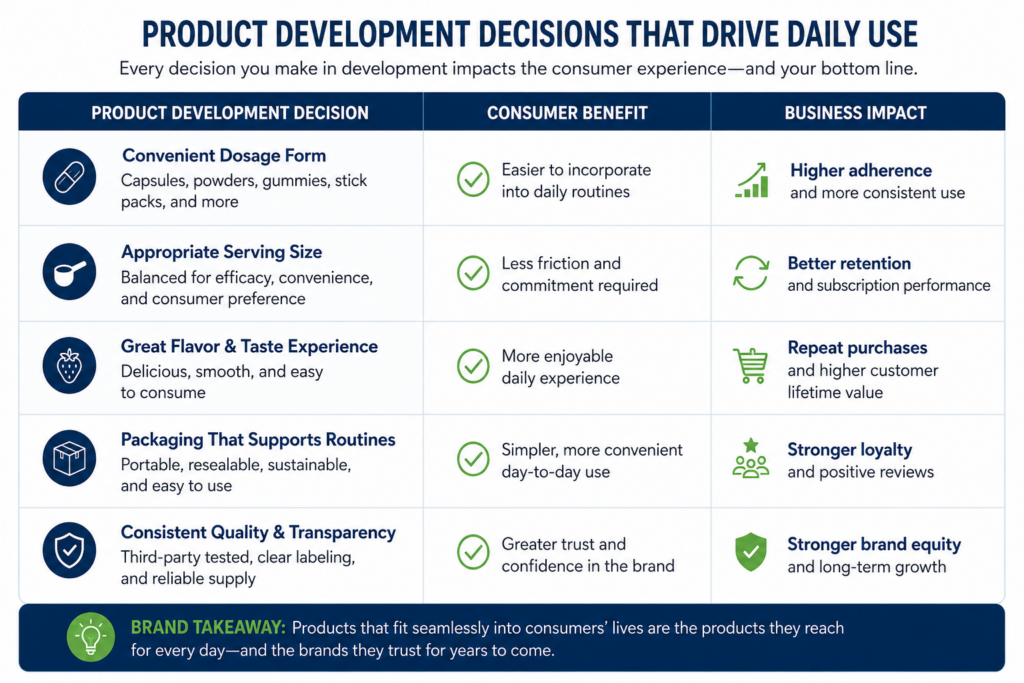
Brands that design around the complete consumer experience are better positioned to improve repeat purchases, strengthen customer loyalty, and build sustainable growth. Every decision, from formulation and serving size to flavor, dosage form, and packaging, influences whether a supplement becomes part of a daily routine or remains on the shelf.
Why Consumer Adherence Matters for Supplement Brands
A supplement cannot deliver its intended benefits if consumers do not take it consistently. That makes adherence more than a product-experience detail: it is one of the clearest links between product development and commercial performance.
When a product becomes part of a daily routine, consumers are more likely to recognize its value, reorder it, maintain a subscription, and recommend it to others. That consistency also creates more predictable demand for the brand and can improve retailer confidence in the product.
The opposite holds too. A product may generate a strong initial sale through effective marketing, but if the serving is inconvenient, the flavor is hard to tolerate, or the benefit is unclear, consumers may abandon it before they experience meaningful results.
For that reason, routine adoption should be treated as a product-development objective from the beginning. Every formulation decision should help answer a practical question: will this make the product easier for consumers to understand, use, and continue purchasing?
Four Principles of High-Adherence Products
McKinsey’s wellness research shows that consumers are looking for solutions that are effective, science-backed, and supported by credible data. That expectation raises the bar for supplement brands: product experience, formulation strategy, and substantiation all need to work together.
1. Design for Convenience
Convenience begins with understanding when, where, and how the consumer will use the product. A powder intended for a morning routine may need different packaging and preparation than a product designed for travel, the gym, or evening use. Dosage form, package size, portability, and serving frequency can all introduce friction, and even small barriers become significant when consumers encounter them every day.
Innova Market Insights’ 2026 packaging trends identify health-forward convenience, personalization, and substantiation as key drivers shaping packaging innovation, including packaging designed around personal occasions and routines. The best product format is therefore not simply the most innovative or economical option. It is the one consumers can use with the least disruption to their normal routines.
2. Communicate One Clear Benefit
Consumers should be able to understand quickly what a product does and why they should use it regularly. A focused benefit is often easier to communicate and trust than a broad formulation that attempts to address many unrelated needs. Clarity also supports merchandising, advertising, and retailer education: when the purpose of a product is immediately recognizable, consumers have an easier time deciding whether it belongs in their wellness routine.
3. Deliver a Consistent Experience
Repeat purchases depend on confidence. Consumers expect the same taste, texture, appearance, quality, and overall experience each time they open a new package. Variability can weaken trust even when a product remains technically within specification. For products used every day, sensory consistency and manufacturing consistency are both essential parts of the brand experience.
4. Build Trust Through Transparency
Mintel’s 2025 U.S. VMS market research notes that consumers are seeking clear ingredient information, tailored solutions, and innovative product formats to justify their investment in supplements. This makes transparency a product strategy issue, not just a label requirement.
Transparency helps meet that need. Responsible claims, understandable ingredient explanations, and clear directions reduce uncertainty before purchase and reinforce confidence afterward. Consumers are more likely to continue using products they can easily understand and explain.
Brand Takeaway: Convenience, clarity, consistency, and transparency work together. A product that is easy to use but hard to trust, or clearly explained but inconsistent from batch to batch, will still struggle to earn a second purchase.
Choosing the Right Product Format
Selecting the right dosage form is one of the most important product development decisions a supplement brand can make. While ingredients define a product’s intended benefits, the format often determines whether consumers use it consistently. The best format is not necessarily the newest or most innovative. It is the one that fits naturally into the consumer’s routine.
Powder sticks, chewables, capsules, and beverage mixes each carry different tradeoffs in convenience, cost, and manufacturability, which is why delivery format innovation has become its own strategic discipline within supplement product development.
Brand Takeaway: Select the dosage form that best supports the consumer’s daily routine, not simply the easiest format to manufacture.
Formulating Products for Long-Term Use
A formulation may look impressive on paper and still be poorly suited to daily use. The challenge is to preserve the product’s intended benefit while making the finished experience realistic for consumers and practical to manufacture at scale.
That starts with ingredient discipline. Every ingredient should contribute meaningfully to the product’s central purpose and earn its place in the formula, ideally in partnership with a custom supplement manufacturer that can validate feasibility at production scale. Clinical support and consumer recognition matter, but so do dose feasibility, ingredient compatibility, stability, sourcing reliability, and the space available in the selected dosage form.
Serving size is often where these considerations meet. Adding more ingredients or increasing individual doses may strengthen the formulation story, but it can also result in several capsules per day, an oversized scoop, or a product that is difficult to flavor. Those tradeoffs can undermine adherence even when the formula is scientifically sound.
For powders, gummies, chewables, and beverage mixes, the sensory experience is equally important, much like the format and flavor innovation already reshaping the creatine category. Taste, sweetness, aroma, texture, and mouthfeel should be developed alongside the formulation rather than addressed at the end. Consumers are unlikely to remain loyal to a product they have to tolerate every day.
Before commercialization, brands should evaluate the finished product from the consumer’s perspective: is the purpose clear, are the directions simple, is preparation easy, is the serving manageable, and does the experience remain enjoyable after repeated use?
The strongest daily-use formulations do not simply contain more ingredients. They balance efficacy, clarity, enjoyment, and convenience in a way consumers can sustain.
Brand Takeaway: Consumers are more likely to remain loyal to products that consistently fit their routines than products that simply contain more ingredients.
Wellness Trends Creating Opportunities
McKinsey found that Gen Z and millennial consumers are purchasing more wellness products and services than older generations across areas such as health, sleep, nutrition, fitness, appearance, and mindfulness. For brands, this points to growing demand for targeted products that feel relevant to specific lifestyles and goals.
Consumer trends provide valuable direction, but successful brands evaluate each opportunity through the lens of long-term consumer engagement. The goal is not to chase every trend, but to develop products consumers will continue purchasing.
Personalized Nutrition
Segment product portfolios around specific consumer needs, such as active lifestyles, healthy aging, gut health, or foundational wellness, rather than creating one product for everyone.
Foundational Wellness
Daily essentials including multivitamins, probiotics, greens, hydration, and fiber remain strong opportunities because they naturally encourage consistent use.
Gut Health
Focus on convenient, approachable products that make digestive wellness easy to integrate into everyday routines.
Hydration
Hydration products build on an existing daily habit, creating opportunities to combine complementary benefits such as energy, beauty, or cognitive wellness.
Healthy Aging
Develop proactive wellness solutions that support long-term vitality with credible science, practical formulations, and consumer-friendly formats.
Brand Takeaway: The strongest product concepts combine meaningful consumer insights with thoughtful formulation and an experience that encourages repeat purchases.
From Product Concept to Consumer Loyalty
Creating a successful daily wellness product requires more than a strong formulation. It requires aligning consumer insights with product development, quality manufacturing, and commercial execution. The right dietary supplement contract manufacturer helps brands make better decisions throughout development, resulting in products consumers trust and continue purchasing.
Consumer-Centered Product Development
Reliance collaborates with brands from concept through commercialization, helping evaluate formulation strategy, serving size, dosage form, flavor, manufacturability, and consumer experience. Addressing these considerations early reduces development challenges and helps position products for long-term success, following the same process outlined in The Ultimate Guide to Contract Manufacturing for Dietary Supplements, from initial concept through full-scale production.
For more than 45 years, Reliance has partnered with leading brands to transform innovative ideas into commercially successful products. That collaborative approach helps customers bring science-backed nutrition to market with confidence, speed, and consistency.
Manufacturing Consistency That Supports Retention
For a daily-use product, each purchase must reinforce the consumer’s confidence in the last one. Trusted ingredient sourcing, rigorous testing, and established quality systems help Reliance deliver a consistent product from batch to batch.
With capabilities across multiple dosage forms and turnkey supplement manufacturing services, Reliance can support both initial product development and continued growth as demand, product portfolios, and market opportunities evolve.
Conclusion
The most successful daily wellness products are designed around consumer behavior as much as formulation science. When brands prioritize convenience, clarity, consistency, and quality throughout product development, they create products that fit naturally into everyday routines and encourage repeat purchases.
By partnering with an experienced contract manufacturer early in development, brands can transform consumer insights into differentiated products that strengthen customer loyalty and support sustainable business growth.