This is part of Ingredient Intelligence, a series tracking where the supplement market is going and what it means for your next SKU.
Executive Summary
Creatine is emerging as a foundational wellness supplement, moving well beyond its performance-focused roots as female demand surges and clinical evidence expands around cognitive function, bone health, and hormonal support. For supplement brands, this shift creates strategic opportunities in multi-benefit formulation, format innovation, and education-led positioning that moves creatine beyond the gym. Companies that treat the women’s creatine opportunity as a formulation and marketing strategy, not simply a trend to chase, will be better positioned for durable category growth and competitive differentiation.
Key Takeaways
- The benefit story is driving the buyer shift, not the other way around, making cognitive health, healthy aging, and hormonal life stages more powerful positioning anchors than athletic performance.
- Format is now a primary competitive differentiator, as ease of use and sensory experience directly drive trial and repeat purchase among women.
- The market penetration gap is an opportunity, not a ceiling, giving first-mover brands room to establish category authority before the market saturates.
- What Is Creatine and Why Is It Resonating with Women?
- A Cultural Shift Driving Demand
- How Women Are Using Creatine Today
- The Format Revolution: Where Innovation Is Happening
- The Market Opportunity: Still Early and Underserved
- The Real Shift: Positioning Creatine for Modern Wellness
- What Brands Need to Get Right
- What This Means for Dietary Supplement Brands
- The Bottom Line
- Frequently Asked Questions About Creatine Supplements for Women
- Ready to Build the Next Generation of Creatine Products?
Creatine is no longer confined to the sports nutrition aisle. It is rapidly becoming a cornerstone of daily wellness. With 75% year-over-year growth across channels, the category is expanding fast, but the real story is who is driving that growth: women.
For brand managers and product developers, this shift signals more than a trend. It represents a repositioning of creatine from performance enhancer to foundational wellness ingredient, and a major opportunity to innovate with the right supplement contract manufacturing partner.
What Is Creatine and Why Is It Resonating with Women?
Creatine is a naturally occurring compound involved in cellular energy production, particularly in muscle and brain tissue. Historically associated with strength and athletic performance, it is now being re-evaluated through a broader health lens.
A Key Biological Advantage
Women typically have lower baseline creatine stores due to physiological differences and lower intake of creatine-rich foods like red meat. This creates a compelling case for supplementation, as the relative impact may be more noticeable.
But biology alone does not explain the surge.
Beyond Muscle: The Expanded Benefit Stack
Today’s positioning extends far beyond muscle-building to include:
- Strength and performance support
- Cognitive function, including focus and mental clarity
- Mood and stress resilience
- Bone health and healthy aging support
- Support across hormonal life stages
For product development leaders, this expanded benefit profile opens the door to multi-functional formulations that appeal to broader wellness use cases, not just athletic performance.
A Cultural Shift Driving Demand
Consumer behavior is evolving alongside the science.
More women are prioritizing strength training over cardio, while platforms like TikTok and Instagram have reframed creatine as a daily wellness essential rather than a niche sports supplement.
The result is clear. Female creatine purchases increased over 300% year-over-year in early 2025.
For brands, this mirrors the trajectory of protein. What was once niche is now mainstream, and creatine appears to be following the same path.
How Women Are Using Creatine Today
Unlike traditional sports nutrition users, women are adopting creatine with simplicity and consistency in mind.
Typical usage patterns include:
- 3 to 5 grams daily
- No loading phase
- Mixed into water, smoothies, or coffee
- Preference for convenient, flavored, or ready-to-consume formats
This has direct implications for formulation strategy. Ease of use often outweighs optimization protocols.
The Format Revolution: Where Innovation Is Happening
One of the most important developments is not just increased usage, but how creatine is being delivered. Creatine delivery format innovation is driving category-wide growth, as brands that match format to lifestyle are capturing both trial and repeat purchase in ways that ingredient quality alone cannot sustain.
Emerging formats include:
- Combination products such as creatine with collagen, electrolytes, or nootropics
- Flavored powders and stick packs
- Beauty-from-within blends
Why This Matters for Brands
This evolution signals a broader shift in how consumers evaluate supplements. Format is no longer a secondary consideration. It plays a central role in product differentiation, influencing everything from first purchase to long-term retention. Taste, texture, and overall user experience now directly impact repeat purchase behavior, while hybrid formulations allow brands to position creatine within multiple wellness categories at once.
As a result, execution becomes critical. Brands that partner with a stick pack supplement manufacturer offering in-house flavoring and advanced formulation expertise are better positioned to deliver products that stand out on the shelf and scale successfully in market.
The Market Opportunity: Still Early and Underserved
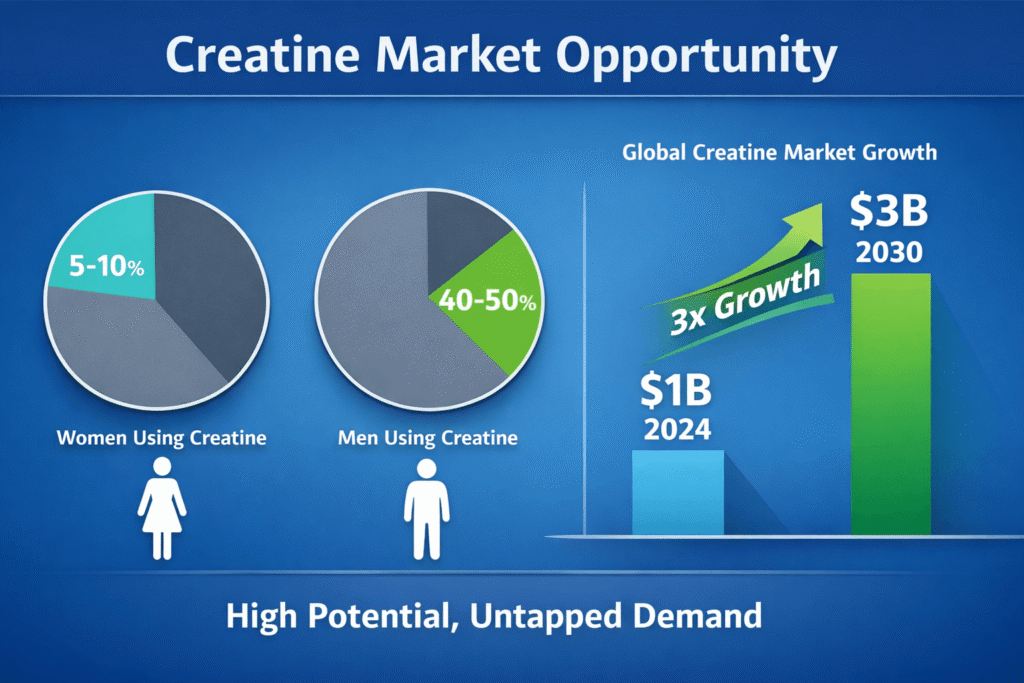
Despite rapid growth, creatine remains significantly underpenetrated among women. Current estimates suggest that only 5 to 10 percent of women use creatine, compared to 40 to 50 percent of men. This gap highlights a substantial white space in the market, particularly as awareness and education continue to improve.
At the same time, the broader category is expanding quickly. The global creatine market is projected to grow from approximately $1 billion in 2024 to nearly $3 billion by 2030.
Taken together, these dynamics point to a rare opportunity. Creatine sits at the intersection of high growth and low saturation among a key demographic, giving brands a clear path to capture share through targeted positioning, innovative formats, and education-driven marketing.
The Real Shift: Positioning Creatine for Modern Wellness
Historically, creatine marketing centered on muscle gain, strength, and athletic performance. This positioning firmly placed it within the sports nutrition category and limited its appeal to a narrower, performance-focused audience.
Today’s leading brands are repositioning creatine around broader, lifestyle-oriented benefits:
- Daily energy for both body and mind
- Strength without bulk
- Cognitive and longevity support
- Foundational wellness supplementation
This evolution reflects a much larger shift in consumer expectations. Creatine is no longer being evaluated solely as a performance ingredient. It is increasingly viewed as a versatile, everyday wellness solution that fits into routines focused on energy, mental clarity, and long-term health.
For brands, this repositioning significantly expands the total addressable market. However, it also raises the bar for execution. Messaging must remain clear, benefit-driven, and compliant with DSHEA guidelines, ensuring claims are both compelling and properly substantiated.
What Brands Need to Get Right
As competition increases, execution becomes the differentiator.
1. Education Is Critical
Misconceptions, especially around weight gain or “bulking,” still exist. Clear, compliant education builds trust.
2. Format Drives Adoption
Convenience-forward delivery formats such as stick packs are key to capturing repeat users.
3. Transparency Builds Trust
Women over-index on:
- Clean labels
- Third-party testing
- Transparent sourcing and CoAs
Brands with a clear branded creatine ingredient strategy satisfy all three by sourcing certified, named ingredient forms with built-in third-party documentation and clinical backing. Learn more by reviewing our supplement contract manufacturing guide, which covers the full landscape of manufacturing partnership evaluation and execution.
4. Benefits Must Match Real Life
Energy, focus, and long-term health resonate more than gym performance alone.
What This Means for Dietary Supplement Brands
The creatine category’s rapid expansion into women’s wellness is creating one of the clearest near-term launch windows in the supplement market. With only 5 to 10 percent of women currently using creatine and female purchases up more than 300 percent year-over-year, brands that enter now have the opportunity to build category authority before saturation sets in. Here are the most important considerations for your brand:
Formulation strategy for multi-benefit blends: Women are adopting creatine for its expanded benefit profile, including cognitive function, mood support, and bone health. Combination products pairing creatine with collagen, electrolytes, or adaptogens are among the strongest differentiation opportunities in the category. Fiber and creatine stack combinations for women’s wellness are also gaining traction as brands build comprehensive daily wellness systems. Building multi-ingredient blends, including those built on a plant protein formulation strategy, requires a formulation partner with expertise in ingredient compatibility, dosage optimization, and stability across blend components.
Format execution and flavor development: Convenience is the primary driver of trial and retention among female consumers, making stick packs and flavored powder formats central to a successful product strategy. Clean flavor profiles that mix easily into water, coffee, or smoothies directly influence repeat purchase. Brands need a manufacturing partner with in-house flavor scientists and stick pack production capability to deliver products consumers will actually use consistently.
Speed-to-market and quality assurance: The creatine category’s growth trajectory rewards first movers, and execution speed matters as much as formulation quality at this stage. Turnkey supplement contract manufacturing that covers formulation, GMP-compliant production, CoA validation, and stability testing allows brands to get to market efficiently while maintaining the quality standards consumers expect. For a comprehensive overview of what to look for in a manufacturing partner, see our guide to the contract manufacturing process. Choosing a partner that handles the complete production cycle without relying on third-party coordination is one of the most strategic decisions a brand can make at this stage of the category.
The Bottom Line
Creatine is undergoing a category transformation. It is moving from a niche performance supplement to a daily wellness staple driven by women.
This shift is redefining:
- Product formats
- Benefit positioning
- Consumer expectations
The brands that move early and execute with the right partner will not just participate in the growth. They will help define the future of the category.
Frequently Asked Questions About Creatine Supplements for Women
†These statements have not been evaluated by the Food and Drug Administration. This product is not intended to diagnose, treat, cure, or prevent any disease.