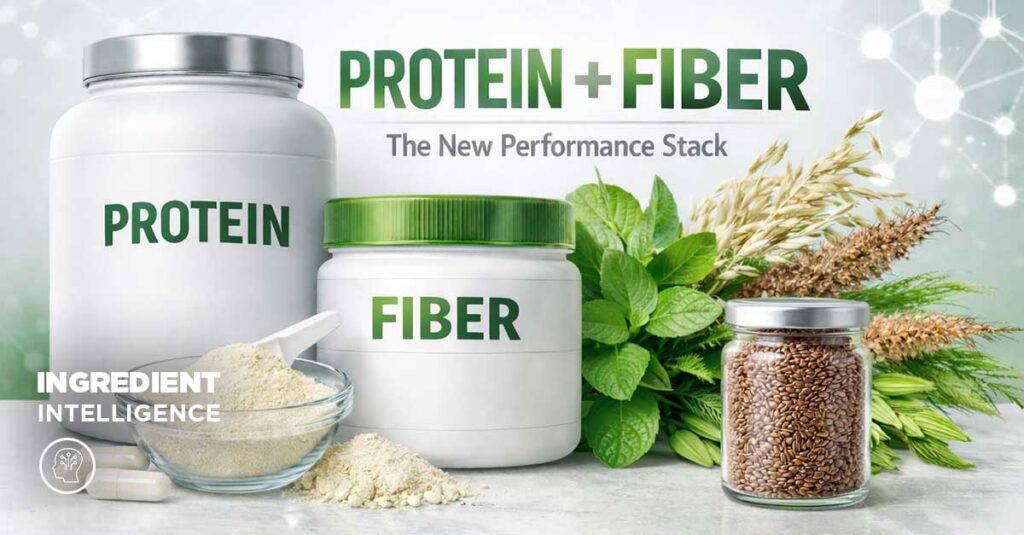
Most supplement brands find out where the market moved after it moved there. Ingredient Intelligence is built for brands that want to get ahead of it.
Each post in this series tracks a category in motion: the scientific shifts, consumer behavior changes, and format innovations that are reshaping what sells, who’s buying, and where the formulation opportunity still exists. The analysis is written for supplement brand managers and product developers who need to make real decisions about what to build next.
- Digestive Enzymes: A Science-Backed Formulation Guide for Supplement Brands
- Beyond Probiotics: What Brands Should Know About Pre-, Pro-, and Postbiotic Formulation
- Multi-Source Collagen Peptides: Why Brands Are Expanding Beyond Traditional Collagen Sources
- Why Creatine for Women Is Reshaping Supplement Innovation
- Fiber Is No Longer the Quiet Nutrient
- How the Plant-Based Protein Market Is Fueling the Next Phase of Supplement Brand Growth
- The Nuts and Bolts of Magnesium
- Ready to Turn Market Intelligence Into Your Next SKU?
Digestive Enzymes: A Science-Backed Formulation Guide for Supplement Brands

Digestive enzyme formulation succeeds or fails on precision: matching a specific enzyme to the substrate it acts on, the part of the gastrointestinal tract where it needs to work, and a measurable activity level under real use conditions, rather than adding more enzymes to lengthen a Supplement Facts panel. Because enzyme potency comes from catalytic activity rather than weight, two products carrying the same milligram amount of a blend can perform very differently, which puts activity units, the assay behind them, and finished-product stability at the center of any credible specification.
What You’ll Learn:
- Substrate Matching: start from the food component the product is meant to break down, and let that decide the enzyme, instead of assembling a panel that only looks comprehensive
- Activity Over Milligrams: see why two products with identical milligram weights can perform differently, and what a specification must name for potency to be measurable
- pH, Timing and Stability: understand how where an enzyme has to work, and how long it has to survive, change both the formula and the dosing instructions
- Claim Discipline: find where a digestion claim becomes a disease claim in FDA’s view, and why that line belongs in the formulation brief rather than in label review
- Use-Occasion Design: build around a defined consumer moment so enzyme choice, dose, and marketing story reinforce one another
Key Insight: Enzyme potency is a function of catalytic activity, not milligram weight, so a credible specification names the activity unit and assay behind it and confirms that activity holds through finished-product shelf life rather than only at incoming-ingredient testing.
READ: Digestive Enzymes: A Science-Backed Formulation Guide for Supplement Brands
Beyond Probiotics: What Brands Should Know About Pre-, Pro-, and Postbiotic Formulation

Purposeful formulation, not ingredient count, separates a differentiated microbiome supplement from a crowded one. Prebiotics, probiotics, and postbiotics each carry distinct scientific definitions, evidence requirements, and manufacturing considerations, from probiotic viability through shelf life to prebiotic dosing and tolerance.
What You’ll Learn:
- The Three Definitions: separate the three biotic categories by their actual scientific definitions, so a product claim rests on what the ingredient is rather than on category momentum
- Where They Diverge: compare the three approaches across mechanism, evidence base, and stability demands before committing a formula to any one of them
- When to Combine: decide whether a synbiotic or multi-biotic concept earns its added complexity, or whether a single category serves the product objective better
- Technical Constraints: work through the viability, moisture control, packaging, and shelf-life testing that determine whether a concept survives to a finished product
- Format Drives Formula: match capsule, powder, stick pack, or gummy delivery to the biotic payload the formula actually has to carry
Key Insight: Purposeful formulation beats ingredient count, and the strongest microbiome products are built around a defined product objective and manufacturing feasibility rather than combining prebiotics, probiotics, and postbiotics simply because all three exist.
READ: Beyond Probiotics: What Brands Should Know About Pre-, Pro-, and Postbiotic Formulation
Multi-Source Collagen Peptides: Why Brands Are Expanding Beyond Traditional Collagen Sources

Collagen has matured from a single-ingredient beauty supplement into one of the supplement industry’s most durable growth categories, and the next phase of differentiation is multi-source formulation. By blending bovine, marine, chicken, and eggshell membrane collagen, brands can span Type I beauty positioning and Type II mobility support in a single product.
What You’ll Learn:
- Collagen Types Decoded: see how Type I, II, V, and X map to beauty, joint, and bone positioning
- Marine and Alternative Sources: learn where marine collagen and eggshell membrane fit and why they command premium positioning
- The Multi-Source Advantage: understand how blended sources unlock whole-body wellness positioning and stronger repeat purchase
- Formulation Levers: weigh source selection, delivery format, flavor, and certification before development starts
Key Insight: Multi-source blending is the category’s next differentiation lever, because combining bovine, marine, chicken, and eggshell membrane lets a single product span beauty, joint, and whole-body positioning that single-source collagen cannot.
READ: Multi-Source Collagen Peptides: Why Brands Are Expanding Beyond Traditional Collagen Sources
Why Creatine for Women Is Reshaping Supplement Innovation

Creatine is emerging as a foundational wellness supplement, moving well beyond its performance-focused roots as female demand surges and clinical evidence expands around cognitive function, bone health, and hormonal support. For supplement brands, this shift creates strategic opportunities in multi-benefit formulation, format innovation, and education-led positioning that moves creatine beyond the gym.
What You’ll Learn:
- Why Women Are Leading: understand what’s driving 300%+ year-over-year growth in female creatine purchases, from shifting fitness habits to social media normalization of creatine as a daily wellness essential
- Format as Differentiator: learn why delivery format has become the primary competitive lever in the women’s creatine category, and how stick packs, flavored powders, and combination products drive trial and repeat purchase
- The White Space: see why only 5 to 10 percent of women currently use creatine, giving early-mover brands a rare window to establish category authority before the market saturates
- Execution Checklist: map the four areas where brands win or lose in this category, from education that addresses misconceptions to format-forward positioning that drives daily use
Key Insight: The benefit story is driving the buyer shift, not the other way around, making cognitive health, healthy aging, and hormonal life stages more powerful positioning anchors than athletic performance.
READ: Why Creatine for Women Is Reshaping Supplement Innovation
Fiber Is No Longer the Quiet Nutrient

Fiber is transitioning from a secondary nutrient to a core growth driver in the dietary supplements and functional nutrition market. SPINS data shows accelerating omni-channel sales, expanding format adoption, and increasing private label penetration, signaling that fiber is becoming a foundational macro rather than a niche claim.
What You’ll Learn:
- Why Fiber Is Accelerating: track the category data showing fiber expanding beyond supplements into everyday foods and beverages, following the same mainstream trajectory that protein took over the past decade
- Protein-Plus-Fiber Opportunity: understand how GLP-1-driven portion behavior and the demand for nutrient density are making fiber a natural formulation pairing with protein in modern supplement SKUs
- What Private Label Is Signaling: read the data behind private label now holding the largest share in the fiber category, and what that threshold means for how branded companies should compete on differentiation
- Three Innovation Lanes: map reformulation of existing SKUs, paired nutrient systems, and format-driven growth as the clearest paths for capturing fiber’s category momentum
- Why Fiber Is a Design Principle: see how younger consumers moving away from extreme diet culture are making fiber a foundational formulation consideration for brands building practical, everyday supplement portfolios
Key Insight: Fiber is moving into the mainstream across supplements, beverages, and everyday nutrition formats, making it a portfolio-level decision rather than a single-SKU opportunity.
READ: Fiber Is No Longer the Quiet Nutrient
How the Plant-Based Protein Market Is Fueling the Next Phase of Supplement Brand Growth

Plant-based protein has evolved from a niche alternative into one of the fastest-growing segments within the $4.1 billion protein powder category, driven by a broad flexitarian consumer base rather than the vegan minority. Forty to fifty percent of U.S. consumers regularly choose plant-based options while only 5-8% identify as vegan or vegetarian, which means the category’s growth engine is everyday wellness behavior, not dietary ideology.
What You’ll Learn:
- Category Trajectory: understand how plant protein has moved from a niche alternative to a core growth driver within a $4.1 billion category, and what the consumer and market signals mean for product positioning decisions
- What Winning Brands Do: learn the three fundamentals that separate high-growth plant protein brands: ingredient transparency, taste and mixability over performance claims, and lifestyle positioning that drives daily use
- Brand Growth Signals: see why everyday wellness behavior, not dietary ideology, is what drives repeat purchase in plant protein, and how brands can position for sustainable category volume
- Manufacturing Fit: explore how Reliance’s powder formulation expertise, in-house flavor scientists, and proven organic stock formulas help brands enter and differentiate in the plant protein category
Key Insight: The winning formula for plant protein brands is everyday positioning, not extreme performance messaging, and brands that lead with taste, digestibility, and clean labels consistently outperform performance-centric competitors on repeat purchase and daily usage.
READ: How the Plant-Based Protein Market Is Fueling the Next Phase of Supplement Brand Growth
The Nuts and Bolts of Magnesium

Magnesium is one of the most misunderstood ingredients in the supplement category, not because the science is unclear, but because the label rarely tells the whole story. Different forms carry dramatically different absorption profiles, tolerance thresholds, and functional applications, and brands that choose based on cost or familiarity alone are leaving real performance on the table.
What You’ll Learn:
- Why Form Matters: understand how the binding compound determines absorption, tolerance, and functional outcomes, and why a higher milligram count does not guarantee better results
- Form-by-Form Breakdown: compare oxide, citrate, chloride, glycinate, and Aquamin across absorption, tolerability, and the use cases each form is actually built for
- Where the Category Is Heading: track the market shifts toward bioavailability-focused, form-specific, and clean-sourced mineral products that label-literate consumers are now demanding
- The Calcium-Magnesium Balance: learn why bone health formulations need both minerals in proper ratio and how magnesium deficiency undermines calcium’s effectiveness
Key Insight: Magnesium form selection is a formulation strategy, and brands that default to oxide risk driving the negative reviews, tolerance complaints, and poor repeat rates that are difficult to recover from once they appear on a product page.
READ: The Nuts and Bolts of Magnesium