
This is part of Ingredient Intelligence, a series tracking where the supplement market is going and what it means for your next SKU.
Executive Summary
Purposeful formulation, not ingredient count, separates a differentiated microbiome supplement from a crowded one. Prebiotics, probiotics, and postbiotics each carry distinct scientific definitions, evidence requirements, and manufacturing considerations, from probiotic viability through shelf life to prebiotic dosing and tolerance. Retail data shows continued growth across the microbiome category, with postbiotic-labeled products expanding fastest, signaling real opportunity for brands pursuing scientifically grounded ingredient innovation. For brand managers and product developers, the strategic priority is matching ingredient science, delivery format, and manufacturing feasibility to a defined product objective rather than maximizing the number of biotic categories in the formula.
Key Takeaways
- Purposeful formulation beats ingredient count, and the strongest microbiome products are built around a defined product objective and manufacturing feasibility rather than combining prebiotics, probiotics, and postbiotics simply because all three exist.
- Formulation success hinges on manufacturing variables, since stability, moisture control, packaging selection, processing conditions, and shelf-life testing determine whether a multi-biotic concept survives the transition from bench to finished product.
- The microbiome category continues to grow, with postbiotic-labeled products expanding fastest, giving brands a fact-based case for pursuing scientifically credible biotic innovation rather than following ingredient trends alone.
- Why the Microbiome Conversation Is Expanding Beyond Probiotics
- What Are Prebiotics, Probiotics, and Postbiotics?
- How the Three Biotic Approaches Differ
- Where Butyrate Fits Into the Conversation
- Does Every Gut Health Formula Need Pre-, Pro-, and Postbiotics?
- Formulating Pre-, Pro-, and Postbiotics Together: Key Technical Considerations
- Delivery Format Can Shape the Formula
- Why Biotic Innovation Matters for Supplement Brands
- Building a Stronger Biotic Product Strategy
- What This Means for Dietary Supplement Brands
- Frequently Asked Questions About Prebiotics, Probiotics, and Postbiotics
- Ready to Explore the Right Biotic Strategy for Your Brand?
Why the Microbiome Conversation Is Expanding Beyond Probiotics
For years, probiotics have been at the center of the digestive health conversation. But as understanding of the gut microbiome has advanced, the category has expanded beyond beneficial live microorganisms alone.
Today, product developers are considering a broader ecosystem that includes the substrates microorganisms use, the live microorganisms themselves, and preparations of inanimate microorganisms and their components. This has brought increasing attention to prebiotics, probiotics, and postbiotics, and to formulations designed to combine multiple approaches.
For supplement brands, the opportunity is more nuanced than simply adding more ingredients or increasing probiotic CFU counts. Developing an effective microbiome-focused product requires understanding what each ingredient contributes, whether the evidence supports the intended positioning, and how the entire formula will perform through manufacturing, storage, and consumer use.
While “complete biotic” is not a formally defined scientific category, the term can be a useful way to describe formulations that combine prebiotic, probiotic, and postbiotic approaches. Understanding the distinctions between these categories is the first step toward deciding whether, and how, they belong together in a finished supplement.
What Are Prebiotics, Probiotics, and Postbiotics?
Although the terms are closely related, each represents a distinct scientific concept.
Prebiotics
Prebiotics are substrates that are selectively utilized by host microorganisms and confer a health benefit.
Many familiar prebiotic ingredients are fermentable carbohydrates or fibers. Common examples include:
- Inulin
- Fructo-oligosaccharides (FOS)
- Galacto-oligosaccharides (GOS)
- Certain resistant starches
Inulin-type fructans, including inulin and FOS, reach the colon largely undigested, where they can be utilized by members of the intestinal microbiota. Human research has evaluated their effects across a range of microbiome and health-related outcomes, although effects depend on the specific ingredient, dose, population, and endpoint being studied.
For formulators, that distinction matters: not every fiber is automatically a prebiotic. To meet the scientific definition, selective utilization by host microorganisms and a resulting health benefit should be demonstrated for the ingredient.
Probiotics
Probiotics are live microorganisms that, when administered in adequate amounts, confer a health benefit on the host.
This definition makes several aspects of probiotic formulation especially important:
- The microorganism must be properly identified.
- Relevant benefits need to be supported by appropriate evidence.
- The amount delivered must align with the evidence supporting the strain or formulation.
- Adequate viable microorganisms must remain through the intended shelf life.
One of the most important principles in probiotic development is that evidence is often strain-specific. Findings associated with one strain should not automatically be extrapolated to another simply because the organisms belong to the same species.
As a result, a higher CFU number alone does not necessarily indicate a better probiotic product. Strain identity, evidence, dosage, viability, manufacturing conditions, packaging, and stability all matter.
Postbiotics
Postbiotics are preparations of inanimate microorganisms and/or their components that confer a health benefit on the host.
This definition is important because postbiotics are sometimes described too simply as “the metabolites produced by probiotics.” Under the ISAPP consensus definition, an effective postbiotic must contain inactivated microbial cells or cell components, with or without metabolites that contribute to the observed benefit.
Unlike probiotics, postbiotics do not depend on microorganisms remaining alive through the shelf life of the product. That distinction can create useful formulation possibilities, particularly for product formats or processing environments that may present challenges for live cultures.
However, “inanimate” does not mean evidence or stability becomes irrelevant. Product developers still need to evaluate the exact preparation, dosage, research, processing requirements, specifications, and finished-product stability.
How the Three Biotic Approaches Differ
At a high level, each category addresses the microbiome from a different direction:
- Prebiotics provide substrates selectively utilized by microorganisms.
- Probiotics deliver live microorganisms with demonstrated health benefits.
- Postbiotics deliver preparations of inanimate microorganisms and/or their components with demonstrated health benefits.
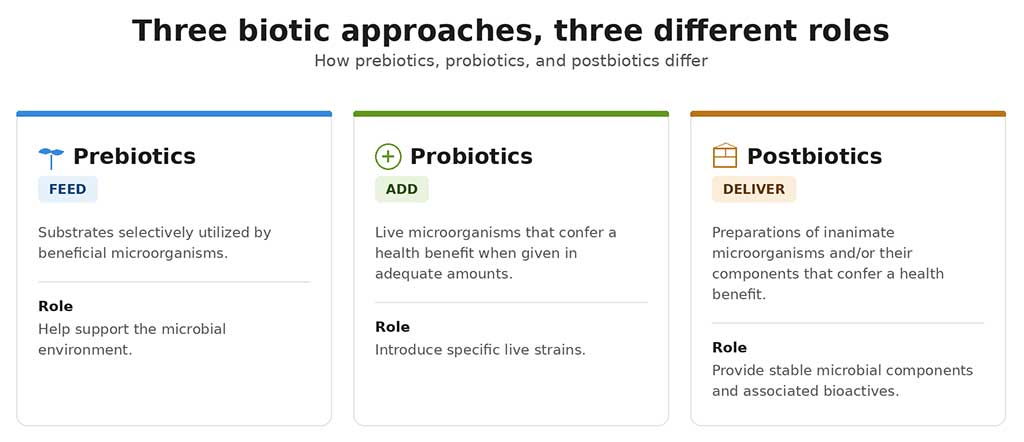
This creates an intuitive formulation framework, but the ingredients should not be viewed as interchangeable. Nor should combining all three automatically be considered more effective.
The value of a multi-biotic formula comes from selecting ingredients that have clearly defined roles, appropriate evidence, compatible dosages, and practical manufacturing characteristics.
Where Butyrate Fits Into the Conversation
The expanding microbiome category has also increased interest in short-chain fatty acids, particularly butyrate.
Butyrate is produced by members of the gut microbiota through fermentation of dietary substrates, including certain fibers. It is an important energy source for colonocytes and has been studied for its role in intestinal homeostasis and gut barrier function.
From a formulation standpoint, it is useful to distinguish prebiotics from the metabolites associated with microbial fermentation. A prebiotic may support microbial activity that contributes to short-chain fatty acid production, but that does not make butyrate itself a prebiotic.
Product developers may encounter several strategies intended to influence or deliver short-chain fatty acids. Each should be evaluated according to its own composition, mechanism, evidence, dosage, sensory characteristics, and formulation requirements rather than treated as equivalent.
Does Every Gut Health Formula Need Pre-, Pro-, and Postbiotics?
No.
A successful microbiome product should begin with the product objective, not with a predetermined number of biotic categories.
For some concepts, a well-supported probiotic strain may be the appropriate solution. Another product may be better suited to a targeted prebiotic, a postbiotic, or a combination.
When deciding whether a broader biotic approach makes sense, brands should consider:
Intended Benefit: What is the product actually intended to support?
Ingredient selection should follow the desired structure/function positioning and supporting evidence, rather than beginning with ingredients and developing a story around them afterward.
Evidence: Does each component have evidence at the proposed dose and in a form relevant to the finished product?
Adding more ingredients can make a Supplement Facts panel look more sophisticated without necessarily creating a stronger evidence base.
Delivery Format: A capsule, stick pack, powder, chewable, gummy, or functional beverage creates very different formulation constraints.
A concept that works technically in a capsule may be difficult to reproduce in a high-moisture or heat-processed format.
Serving Size: Prebiotic fibers may require gram-level quantities, while probiotic and postbiotic ingredients can have very different inclusion rates.
That can quickly make serving size a major product-development consideration, particularly for capsules or other space-constrained formats.
Consumer Experience: Taste, texture, dispersibility, convenience, and gastrointestinal tolerance can be just as important to repeat use as the ingredient story.
A simpler formula that delivers the intended benefit and a strong product experience may ultimately be more compelling than a highly complex formulation.
The goal should therefore be purposeful formulation, not simply maximum ingredient count.
Formulating Pre-, Pro-, and Postbiotics Together: Key Technical Considerations
Combining multiple microbiome-focused ingredients can create formulation opportunities, but it also adds complexity.
Probiotic Viability Through Shelf Life
Probiotic organisms must remain viable at an appropriate level through the intended shelf life, not simply at the time of manufacture.
Processing and storage conditions can affect probiotic survival. Temperature, moisture, oxygen exposure, food or supplement matrix, and storage conditions are among the variables that can influence viability.
This means formulation teams should consider:
- Expected viability loss over time
- Appropriate initial inputs or overages when justified
- Manufacturing temperatures
- Moisture exposure
- Packaging barrier properties
- Storage conditions
- Shelf-life testing
The appropriate strategy is strain- and product-specific.
Ingredient Compatibility
Putting independently researched ingredients into one formula does not automatically mean they will perform identically when combined.
Formulators should evaluate interactions among fibers, microorganisms, minerals, botanical ingredients, flavors, sweeteners, excipients, and other components of the formula.
Compatibility can affect physical stability, moisture, flow, taste, dispersibility, and, in products containing probiotics, microbial viability.
Prebiotic Dose and Tolerance
Prebiotics may require meaningful quantities to align with the evidence supporting the ingredient. Higher amounts of rapidly fermentable carbohydrates can also affect gastrointestinal tolerance in some consumers.
The formulation challenge is therefore to balance:
- Evidence-based inclusion levels
- Serving size
- Consumer tolerance
- Product format
- Sensory characteristics
- Intended frequency of use
This becomes particularly important for daily-use powders and stick packs where relatively large amounts of prebiotic material can be incorporated.
Moisture and Packaging
Moisture management can be especially important in products containing live microorganisms.
Depending on the formula, packaging choices may include moisture-barrier bottles, desiccants, blister configurations, sachets, or stick packs. The right system should be selected based on the finished product’s stability requirements rather than packaging preference alone.
Packaging should therefore be considered part of formulation development, not simply a final commercialization decision.
Manufacturing Conditions
Heat, humidity, compression forces, mixing time, and other manufacturing variables can affect ingredients differently.
Postbiotic preparations may provide more flexibility than live cultures in some applications because their benefit does not depend on maintaining microbial viability. Nevertheless, ingredient-specific processing limitations still need to be considered.
This is one reason early collaboration between R&D, ingredient suppliers, quality teams, manufacturing, and packaging, whether in-house or with a dietary supplement contract manufacturer, can reduce costly reformulation later.
Testing and Specifications
A sophisticated biotic formula also requires a thoughtful quality strategy.
Depending on the ingredients and product, this may include evaluation of:
- Raw-material identity
- Microbiological specifications
- Strain identity
- Probiotic viable counts
- Ingredient potency
- Contaminants
- Finished-product specifications
- Stability over the intended shelf life
- Certificate of Analysis (CoA) requirements
Testing should be aligned with the characteristics that matter for the specific formula rather than approached as a one-size-fits-all checklist.
Delivery Format Can Shape the Formula
Pre-, pro-, and postbiotic supplements can potentially be developed in a range of formats, including:
- Capsules
- Powders
- Stick packs
- Chewables
- Gummies, where ingredient and process conditions are appropriate
- Functional food and beverage applications
Choosing the format first can sometimes limit ingredient and dosage options. Conversely, choosing ingredients before considering the final delivery format can create manufacturing challenges later.
For brands, the strongest development process considers ingredient science, dosage, stability, manufacturing feasibility, packaging, and consumer experience together.
Why Biotic Innovation Matters for Supplement Brands
Consumer interest in digestive health has evolved into a broader conversation around the microbiome, creating room for brands to differentiate beyond traditional probiotic positioning.
Recent retail performance also demonstrates continued activity across the category. An internal analysis of SPINS Natural Channel + MULO data, powered by Circana, found that products containing “prebiotic” or “probiotic” in the product name generated approximately $2.26 billion in dollar sales during the 52 weeks ending July 12, 2026, an increase of $80.3 million, or 3.7%, versus the prior-year period. Unit sales increased 1.2% to approximately 89.0 million units.
Products containing “post” in the product name represented a much smaller $70.8 million in sales, but grew considerably faster during the same period: dollar sales increased 18.7%, while unit sales increased 49.8% (Reliance Vitamin internal analysis of SPINS Natural Channel + MULO, powered by Circana, 52 weeks ending July 12, 2026).
Because this analysis uses product-name search terms, the figures should be viewed as a directional assessment of retail activity rather than a formal measurement of the entire prebiotic, probiotic, or postbiotic market.
For brands, the significance is not simply that another ingredient category is growing. It is that the microbiome conversation is becoming more sophisticated.
Consumers are encountering concepts involving probiotics, prebiotics, postbiotics, the gut-brain connection, metabolic wellness, and highly visible adjacent topics such as GLP-1. That environment creates opportunities for education and innovation, but it also raises the bar for scientific accuracy and responsible product positioning.
The brands that stand out will be those that can explain why each ingredient belongs in the formula, not simply list more microbiome-related terms on the label.
Building a Stronger Biotic Product Strategy
A well-developed microbiome supplement should connect four elements:
1. A Clear Consumer Need: Define the intended product benefit and target user before selecting ingredients.
2. Evidence-Based Ingredient Selection: Evaluate evidence for the exact ingredient, strain, preparation, and dosage whenever possible.
3. Formulation and Manufacturing Feasibility: Whether formulating in-house or working with a partner for custom supplement manufacturing, consider stability, compatibility, serving size, process conditions, testing, and packaging early in development.
4. Clear and Responsible Positioning: Claims and marketing language should accurately reflect the evidence supporting the finished product and comply with applicable dietary supplement requirements.
When these elements align, brands have a stronger foundation for creating products that are differentiated for meaningful reasons, not simply because they contain the newest ingredient terminology.
What This Means for Dietary Supplement Brands
Turning a multi-biotic concept into a finished product means resolving formulation and manufacturing decisions that ingredient education alone will not answer. Here are the most important considerations for your brand:
Market Opportunity: The postbiotic growth documented earlier is the kind of signal that rewards moving early. A small base expanding that quickly means positioning options are still open, and the brands that define the category language tend to be the ones already in market when the volume arrives.
Formulation: Combining prebiotic, probiotic, and postbiotic ingredients in one formula means confirming probiotic viability through the full shelf life, not just at manufacture, while checking how fibers, live cultures, minerals, and flavors interact. Prebiotic levels have to be balanced against gastrointestinal tolerance and serving size, especially in powders and stick packs carrying meaningful fiber per dose. Where the goal is digestive comfort at the meal rather than microbiome support over time, pairing digestive enzymes with prebiotics addresses a different mechanism, with its own activity and stability requirements. Postbiotics relax some of these constraints, because their benefit does not depend on keeping microorganisms alive, which opens processing and packaging options a live-culture formula cannot use.
Format: Capsules, powders, stick packs, chewables, gummies, and functional beverages expose a biotic formula to different heat, humidity, and compression conditions, and picking format after the ingredient list is set is a common source of late-stage reformulation. Moisture-barrier packaging, desiccants, and container selection belong in the format decision itself, not a final commercialization step, particularly for products carrying live probiotic strains. Testing and specifications, from strain identity to probiotic viable counts, need to be built around the format the product will ship in.
Capturing the postbiotic opportunity, formulating for viability and compatibility, and building to the right format are one production decision, not three. A probiotic contract manufacturer works through all three before a formula reaches the plant floor, a different conversation than sourcing ingredients alone.